PROCESSO DE REVISÃO DE ZONEAMENTO DA RBCV - FASE II / 2008
Rodrigo Antônio Braga Moraes Victor
Francisco de Assis Honda
Marina Mitsue Kanashiro
Vanessa Cordeiro de Souza
Bely Clemente Camacho Pires
Endereço: Rua do Horto, 931 – Instituto Florestal
São Paulo – SP CEP 02377-000
Telefax: ++(5511) 2232 3116 / 2231 8113
@: rbcv_sp@yahoo.com.br
PROCESSO DE REVISÃO DO ZONEAMENTO
RESERVA DA BIOSFERA DO CINTURÃO VERDE DA CIDADE DE SÃO PAULO
São Paulo, setembro de 2008
4.1 – Antecedentes
A área englobada pela Reserva da Biosfera do Cinturão Verde da Cidade São Paulo – RBCV é anfitriã de uma notável diversidade biológica e fornece uma ampla gama de serviços ambientais prestados pelos ecossistemas à sociedade como: alimentos, água, estabilização climática, controle de erosão, perdas de solo e de inundação, seqüestro de CO2, turismo, lazer, qualidade estética, fitoterápicos entre muitos outros. Esses serviços são vitais para assegurar o bem-estar das populações - aproximadamente 23 milhões de pessoas – que vivem dinamicamente em uma área que produz cerca de 20% do PIB brasileiro.
O Cinturão Verde da Cidade São Paulo foi declarado Reserva da Biosfera em 1993, na sequência de um movimento cívico que, desde finais dos anos 80 reivindica por um sistema de gestão participativo e integração das estratégias de conservação dos recursos naturais em torno de uma das maiores metrópoles do mundo.
Nessa altura, uma outra iniciativa para a declaração da Reserva da Biosfera estava em andamento, mas que visando uma área muito maior: o litoral brasileiro reconhecido como bioma Mata Atlântica (Mata Atlântica). Articulou e comandou em nível nacional pelo Consórcio Mata Atlântica, a primeira fase de criação da Reserva da Biosfera da Mata Atlântica, sendo aprovado em 1991.
Devido a sobreposição das áreas, o Comitê Brasileiro MaB e o MaB Secretaria, advogaram o arranjo institucional capaz de acomodar esses dois movimentos legítimos inovadores, mantendo ambas identidades. Foi então definido que a Reserva da Biosfera do Cinturão Verde da Cidade São Paulo seria parte integrante da Reserva da Biosfera da Mata Atlântica, mas articulada e com sistemas de gestão autônomos.
Ao longo dos anos, esta estrutura funcional provou ser eficiente para a existência das duas Reservas Biosfera que:
i) Negociam com questões em suas próprias redes de projetos.
ii) Mantem integrações mútuas e de cooperação institucional e programática.
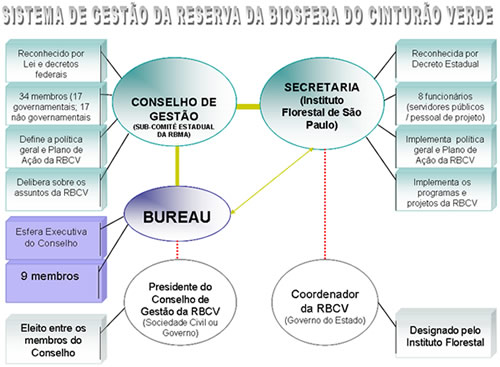
A Reserva da Biosfera do Cinturão Verde da Cidade São Paulo tem um sistema de gestão constituído por um Conselho de Gestão, um Bureau e uma Coordenação Executiva. O Conselho tem 34 membros, uniformemente composto por representantes governamentais e não governamentais. A Coordenação Executiva é fornecido pelo Instituto Florestal do estado de São Paulo. Conforme apresentado no Anexo 1; ao Conselho de Gestão e ao Bureau, cabem definir a política geral da RBCV e o Plano de Ação, enquanto a Coordenação cabe implementá-las.
Considerando que a Reserva da Biosfera da Mata Atlântica realizou 5 revisões do zoneamento entre o período 1991-2002, sendo este atual um dos 6, a Reserva da Biosfera do Cinturão Verde da Cidade São Paulo ficou com o seu zoneamento e os limites originais até este momento de revisão da fase VI.
A Reserva da Biosfera do Cinturão Verde da Cidade São Paulo com seu Plano de Ação aprovado em junho de 2006, definiu que o seu zoneamento deve ser revisto. Em 2007, os procedimentos de revisão do zoneamento foram iniciados e, em 2008, foi acordado com o Conselho Nacional da Reserva da Biosfera da Mata Atlântica de que ambos os processos devem constituir um único projeto a ser encaminhado as autoridades especializadas para a análise.
Embora este processo de revisão do zoneamento tenha sido desenvolvido em plena interação com a Reserva da Biosfera da Mata Atlântica, foi utilizado um material complementar, com métodos e critérios para satisfazer as necessidades e desafios específicos de gestão da Reserva da Biosfera do Cinturão Verde da Cidade São Paulo, como segue.
4.2 Revisão de Metodologia e Critérios:
Como seria de se esperar de uma área altamente urbanizada e de grande complexidade, o processo de revisão zoneamento da RBCV utilizou um vasto conjunto de critérios e métodos específicos. Quatro critérios principais, no entanto, orientou o processo de revisão geral do zoneamento da Reserva da Biosfera do Cinturão Verde da Cidade de São Paulo:
a) Áreas já classificadas com seus zoneamentos ou simples atualizações:
Desde o primeiro zoneamento inicial, várias áreas protegidas, dentro de diferentes categorias de manejo foram criados no território da Reserva da Biosfera. Estritamente áreas protegidas como parques estaduais e/ou parques naturais municipais das cidades eram imediatamente classificados como zonas núcleo. Outros como Áreas de Proteção Ambiental (APAs), por intermédio da proteção jurídica, foram automaticamente consideradas zonas-tampão (amortecimento). Essa classificação tem sido utilizada desde a nomeação da RBCV e mantém-se inalterada conceitualmente. Além disso, vários se não a maior parte das áreas mantida na revisão do zoneamento original, ainda cabem perfeitamente na maioria dos conceitos modernos adotados pelo atual zoneamento.
b) Novos conceitos como discutido no Congresso Mundial de Reservas de Biosfera realizado em Madri:
Os novos papéis que Reservas de Biosferas devem desempenhar no mundo contemporâneo, assim como as suas funções de zoneamento, foram amplamente abordadas antes e durante o Congresso de Madri realizado em 2008. Os documentos e os antecedentes do próprio plano de Madri são extremamente inspiradores como a forma de interações de uma Reserva da Biosfera e suas zonas possam melhor responder aos desafios da urbanização, as alterações climáticas e as necessidades de serviços ambientais prestados pelos ecossistemas. Para esse efeito, a ampliação de mais zonas se faz necessário, bem como funções mais proativas. Por exemplo, zonas-tampão (amortecimento), protegendo ao mesmo tempo as áreas essenciais, ambos devem funcionar como corredores ecológicos e de biodiversidade e, áreas de relevante interesse importância próprias conectadas. Estes conceitos utilizados de grande extensão já estavam presentes no antigo zoneamento da RBCV e, agora foram completamente integrados no processo de revisão 2008. Um bom exemplo disso é que muitas das zonas-tampão (amortecimento) não necessariamente envolvem as zonas núcleos.
c) O Manual de Revisão do Zoneamento de Reserva da Biosfera da Mata Atlântica:
Conselho Nacional da Reserva da Biosfera da Mata Atlântica empreendeu um notável trabalho de adaptar os conceitos de Reserva da Biosfera internacional para o conceito de zoneamento legais brasileiros, contextos institucionais e ecológicos. Isso foi compilado em um manual de orientação para os seus processos globais de revisão em 16 estados brasileiros (o manual encontra-se neste documento da Parte II - Guia Metodológico: Reserva da Biosfera Mata Atlântica - Fase VI). Muitos dos manuais também foram critérios utilizados para a Reserva da Biosfera do Cinturão Verde da Cidade São Paulo na revisão do zoneamento 2008.
d) Critérios específicos para áreas urbanizadas:
No ano de 2001, o Programa MaB lançou um grupo de trabalho, o Grupo MaB Urbano, para fornecer detalhes sobre os fundamentos e as vantagens da aplicação do conceito de Reserva da Biosfera em áreas urbanizadas. O grupo construiu uma sólida estrutura conceitual sobre Reservas Biosfera Urbana para inspirar tanto as RBs já existentes, como a um número considerável de procura ao site para nomeação.
Dentre os vários documentos apresentados, dois são realmente instrumental em elucidar o conceito:
i) "Reservas de Biosfera Urbana, no âmbito do Quadro Legal e da Estratégia de Sevilha a Rede Mundial de Reservas Biosfera" (UNESCO, 2003); e
ii) “Reservas de Biosfera Urbana-Um Relatório do Grupo MaB Urbano "(UNESCO,2006) (Anexo 2).
Sendo um exemplo tipicamente urbano / periurbano o da Reserva da Biosfera do Cinturão Verde da Cidade de São Paulo, definiu-se um conjunto de critérios específicos da dinâmica urbana para melhor trazer o conceito Reserva da Biosfera em áreas mais densamente urbanizadas. De fato, apesar de ser uma envolvente metrópole na escala mundial, as Reservas de Biosferas antigamente eram mais restritas às zonas rurais e periurbanas. Considerando a crescente compreensão e amadurecimento sobre os conceitos de biodiversidade e dos serviços ambientais ligados aos ecossistemas em paisagens urbanas, e, em última análise, o grau em que as Reservas de Biosfera podem contribuir para melhorar a gestão urbana; o processo de revisão do zoneamento cria critérios para "entrar" no tecido urbano. Inicialmente, a equipe técnica da RBCV e o Bureau envolvidos no processo de revisão do zoneamento da RBCV considerou oportuno classificar formalmente toda a zona urbana como uma zona de transição "especial". A idéia sofreu alguns questionamentos de ordem técnica, porém, ela mostrou-se bastante controversa e favorável as questões do meio ambiente urbano.
A fim de alcançar um consenso sobre esta questão, a equipe técnica de revisão da RBCV encaminhou a proposta para definir critérios específicos para a inclusão oficial das zonas urbanas.
Apesar de o grupo considerar que estes critérios são inacabados, as seguintes categorias foram utilizadas nesta etapa da revisão:
d.1 – Rede de áreas verdes urbanas:
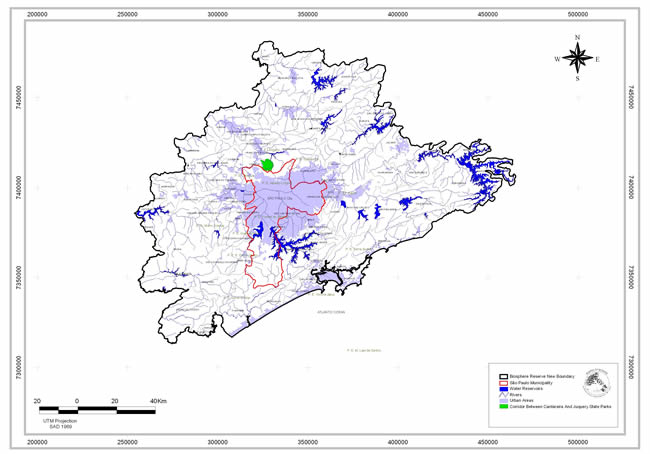
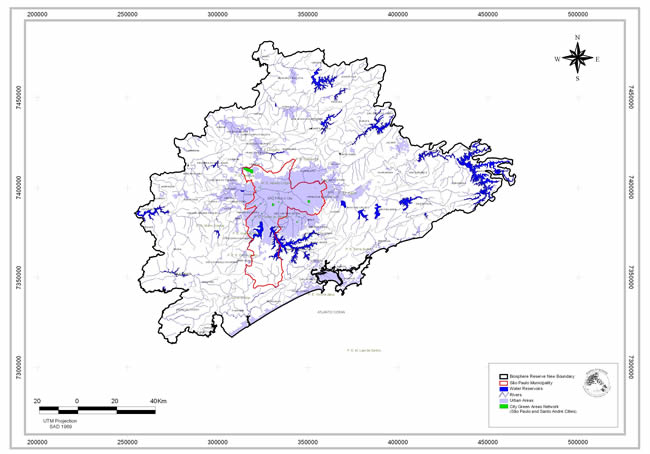
As áreas verdes no interior das cidades são fundamentais para um número considerável de espécies vegetais e animais, além desempenhar um importante papel de interação com os ecossistemas e os serviços ambientais prestados diretamente a população das grandes cidades como quantidade e qualidade das águas, regulação climática, controle das enchentes, proteção dos solos, recreação, turismo, entre outros. Essas áreas exercem perfeitamente o elo de interligação dos fragmentos florestais, funcionando como corredores ecológicos e de biodiversidade "conceitos discutidos no Congresso Mundial da Rede de RBs realizado em Madri 2008” documentos de referência. Por estas características, a rede de áreas verdes da cidades de São Paulo e Santo André foram classificadas na categoria de zonas-tampão (Amortecimento). O acesso aos bancos de dados gerenciados por meio de geotecnologias “GIS”, ou mesmo a ausência de base de informações digitalizadas, impediram a inclusão de demais municípios nesta fase de revisão do zoneamento da RBCV; elaboração e sistematização das informações que são esperados para as próximas rodadas de revisão.
d.2 – Degradação - Integração com planos diretores municipais:
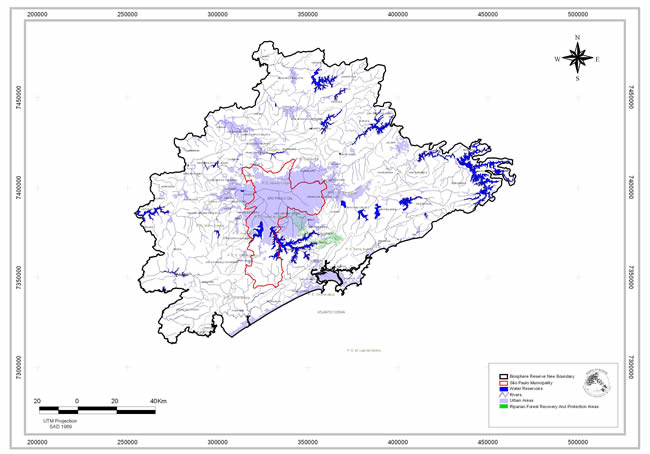
Um importante passo para a aplicação do conceito de Reserva da Biosfera para a região urbana, é permitir a tomadores de decisão integrar programas e projetos de conscientização que realizem, ao longo da sua gestão, estratégias de articulação extremamente eficazes. No entanto, em alguma dessas situações as Reservas Biosfera se apresentam como plataformas para discutir as diversas categorias de uso e ocupação do solo e da terra, contemplando as mudanças que futuramente podem reverter em muito a reconstrução das paisagens e ecossistemas locais. As possíveis áreas de degradação ambiental representadas e classificadas no zoneamento de Reservas da Biosfera de a acordo com suas funções, podem corresponder para os municípios e seus respectivos Planos Diretores uma estratégia eficaz voltados a recuperação de áreas degradadas e reconstrução das paisagens naturais das cidades. No entanto, considerando uma região composta por 78 municípios, como é o caso do Cinturão Verde da cidade de São Paulo, é um enorme desafio e compromisso gerar estratégias de ação que envolvem muito tempo e recursos financeiros para o desenvolvimento de todo o processo. Portanto, considerando que a decisão de seguir esse rumo foi tomada, não se espera que seja cumprida a curto prazo. Por esta razão, e tendo em conta as limitações de tempo e disponibilidade de banco de dados para esta primeira fase de revisão da RBCV, as informações a partir de apenas um plano diretor do município de Santo André (localizado na parte sudeste da cidade de São Paulo), foi representado nesta fase do zoneamento da RBCV. Nesse caso, como pode ser visto no ANEXO 10, a Zona de Especial Interesse Ambiental (referindo-se as áreas de mata ciliar, conservação e recuperação e áreas de preservação permanentes - APPs) conforme definido no Plano Diretor da Cidade foram classificadas como zonas-tampão (amortecimento).
d.3 – Área de Proteção dos Mananciais:
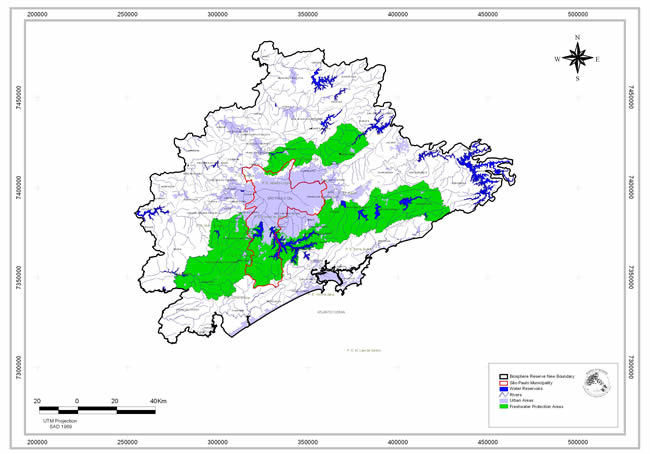
Afim de proteger as nascentes e cabeceiras, rios e reservatórios responsáveis pelo abastecimento da maior parte da população da Grande São Paulo com água de qualidade, uma lei específica foi criada nos anos setenta com o objetivo de controlar a utilização das terras nessas áreas estratégicas. Com base na mesma lei, estruturas legais atualizadas estão a espera de serem criadas para proteger mais diretamente as fontes de água doce altamente ameaçadas.
Embora parte significativa destas Áreas de Proteção aos Mananciais (APM) sofreram processos de degradação e ocupação desordenada ao longo dos anos, sobretudo na face sul da região metropolitana, ainda detêm uma importância vital para o abastecimento da metrópole de São Paulo. Por esse motivo, suas áreas não urbanizadas foram classificadas como zonas-tampão (amortecimento).
É de extrema importância salientar que as categorias de Reservas de Biosfera sob item "d" tem alto significado às críticas relacionadas sobre as questões como conservação e recuperação ambiental, educação ambiental, incentivo às iniciativas de desenvolvimento sustentável, a inclusão social, entre outras atividades que os torna ainda mais adequado para classificá-las como zonas tampão (amortecimento).
Os critérios descritos acima e suas especificidades (ou camadas) foram utilizadas para compor cada zona da Reserva da Biosfera da seguinte forma:
4.3 Categorias do zoneamento da Reserva da Biosfera do Cinturão Verde da Cidade de São Paulo - RBCV
4.3.1 Zonas Núcleo (de acordo com o Sistema Nacional de Unidades de Conservação)
4.3.1.1 Áreas de Proteção Integral (Parques federais, estaduais e municipais, estações ecológicas, reservas biológicas, monumentos naturais, refúgios de vida silvestre e as Reservas Particulares do Patrimônio Natural – RPPN)
4.3.1.2 Zonas de Vida Silvestre das Áreas de Proteção Ambiental - APAs definidas em seu zoneamento
4.3.2 Zonas de Amortecimento e Conectividade:
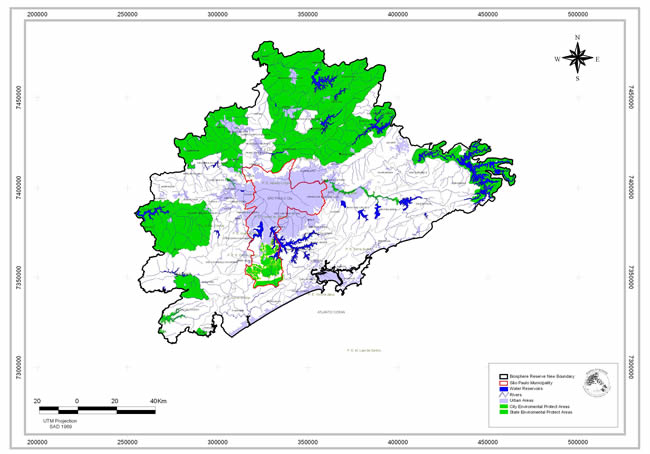
4.3.2.1 Áreas de Proteção Ambiental – APAs (estaduais e municipais)
4.3.2.2 Áreas de Proteção aos Mananciais - APM
4.3.2.3 Rede de parques e áreas verdes dos municípios de São Paulo e Santo André
4.3.2.4 Zona Especial de Interesse Ambiental (referindo-se a mata ciliar como áreas para conservação e recuperação, áreas de preservação permanentes - APPs) do município de Santo André - Integração com os Planos Diretores municipais.
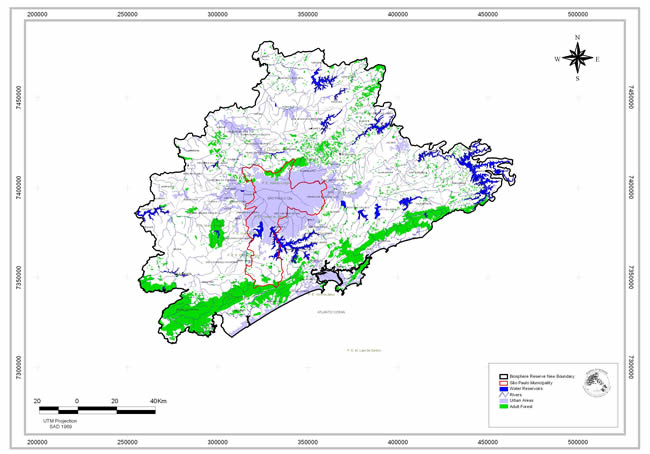
4.3.2.5 Florestas Maduras (Inventário da cobertura vegetal do Estado de São Paulo – IF)
4.3.2.6 Corredor ecológico e de biodiversidade entre os PE da Cantareira e do Juquery
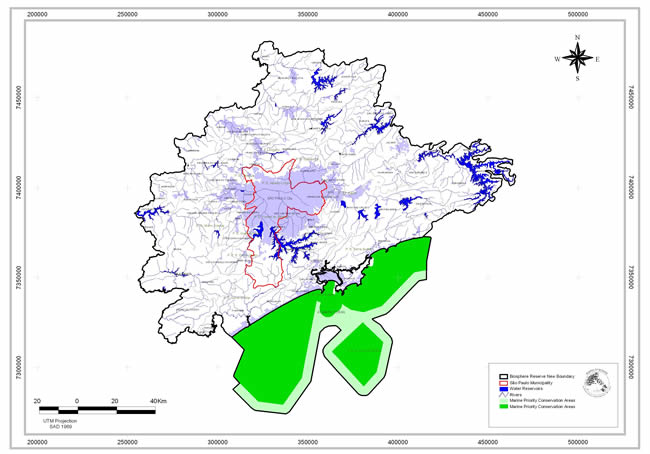
4.3.2.7 Áreas prioritárias para conservação marinha
4.4 Zonas de Transição e Cooperação:
4.4.1 As áreas restantes, com exceção das grandes manchas urbanas.
Síntese da metodologia de revisão do zoneamento da RBCV, critérios e informações adicionais.
ZONAS |
CATEGORIAS CONSTITUINTES (CAMADAS) |
GRAU DE PROTEÇÃO LEGAL |
ESTADO DE CONSERVAÇÃO |
CRITÉRIOS UTILIZADOS |
N° ANEXO |
ZONAS NÚCLEO |
Áreas de Proteção Integral (Parques federais, estaduais e municipais, estações ecológicas, reservas biológicas, monumentos naturais, refúgios de vida silvestre e as Reservas Particulares do Patrimônio Natural – RPPN) |
MUITO ALTA |
MUITO BOA A EXCELENTE |
a, b, c |
3 |
Zonas de Vida Silvestre das Áreas de Proteção Ambiental – APAs |
MUITO ALTA |
MUITO BOA A EXCELENTE |
b, c |
4 |
ZONA DE AMORTECIMENTO E CONECTIVIDADE |
Áreas de Proteção Ambiental – APAs (estaduais e municipais) |
MÉDIO A ALTA |
MÉDIO A MUITO BOA |
a, b, c |
5 |
Áreas de Proteção aos Mananciais (exceto áreas urbanizadas) |
MÉDIO A ALTA |
BAIXA A MUITO BOA |
d.3 |
6 |
Florestas Maduras |
MÉDIO A ALTA |
BOA A MUITO BOA |
b |
7 |
Corredor Ecológico e de Biodiversidade entre os Parques Estaduais da Cantareira e Juquery |
MÉDIO A ALTA |
BOA |
b, c |
8 |
Rede de parques e áreas verdes dos municípios de São Paulo e Santo André |
MÉDIO A ALTA |
BAIXA A BOA |
b, d.1 |
9 |
Zona Especial de Interesse Ambiental (referindo-se a mata ciliar áreas de conservação e recuperação e APPs) do município de Santo André |
MÉDIO A ALTA |
BAIXA A BOA |
b, d.2 |
10 |
Áreas prioritárias para conservação marinha |
BAIXO A MÉDIA |
- |
b, c |
11 |
ZONA DE TRANSIÇÃO E COOPERAÇÃO |
As áreas restantes, com exceção das grandes manchas urbanas |
BAIXO A MÉDIA |
BAIXA A BOA |
a, b, c, d |
12 |
4.5. Alterações dos limites da Reserva da Biosfera do Cinturão Verde da Cidade de São Paulo - Metodologia e Critérios
Além do processo de revisão do zoneamento descrito acima, a Reserva da Biosfera do Cinturão Verde da Cidade São Paulo também propôs a expansão de seus limites, especialmente com a incorporação de uma grande área marinha adjacente. Também, em uma situação particular, uma área muito pequena é proposta para ser excluída dos limites originais da RBCV.
As mudanças dos limites propostas foram as seguintes:
4.5.1 Alterações nos limites terrestres:
A RBCV propôs uma expansão terrestre em ambos os limites leste e oeste. Essas expansões não incorporam áreas significativas eos ajustes visam apenas inserir a totalidade das Áreas de Proteção Ambiental - APAs já existentes na RBCV em ambas as faces e suas referidas áreas de proteção dos reservatórios e mananciais em sua totalidade.
Com a mesma intenção de seguir a linha de demarcação de uma área protegida na porção oriental da RBCV, uma área muito pequena, está sendo removida.
Estas mudanças propostas foram as seguintes:
4.5.1.1 Alterações na face leste:
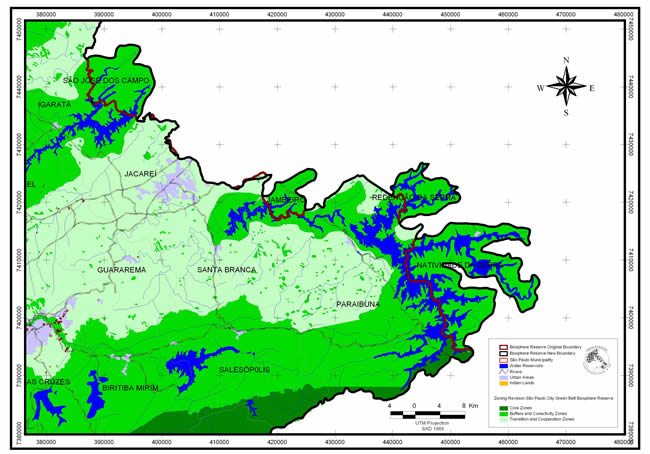
Os limites propostos na face leste foram indicados de forma a coincidir com toda a área da APA dos mananciais do Vale do Rio Paraíba do Sul e as bacias e subbacias dos reservatórios de Paraibuna. Isso também explica a redução das pequenas áreas.
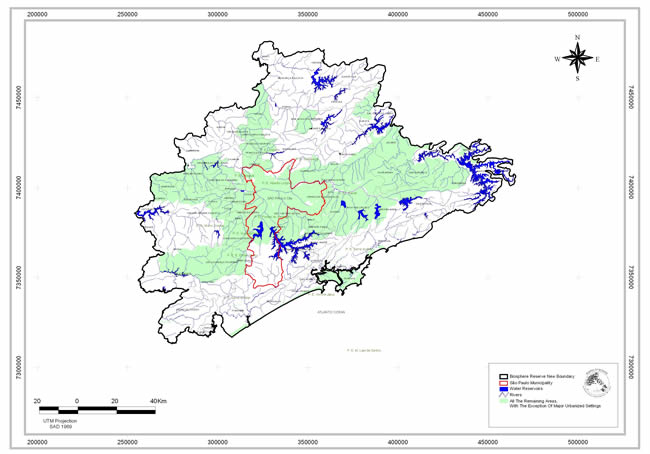
Estas alterações integram parcialmente 4 novos municípios ao território da Reserva da Biosfera do Cinturão Verde da Cidade de São Paulo: Redenção da Serra, Natividade da Serra, Jambeiro e São José dos Campos. Por outro lado, a pequena área subtraída da RBCV, ainda se mantém no território da Reserva da Biosfera da Mata Atlântica, o que impede essa decisão de ter quaisquer consequências políticas relevantes. O anexo 13 ilustra essas mudanças.
4.5.1.2 Alterações na face oeste:
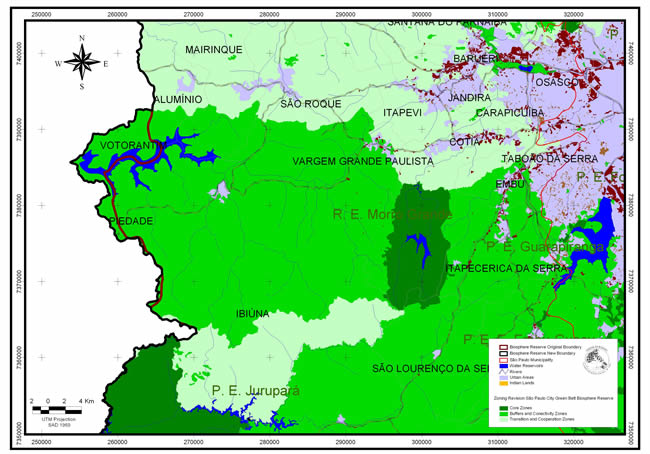
Os limites propostos no lado ocidental foram para coincidir com a borda da APA de Itupararanga, inserindo-a em sua totalidade aos limites da RBCV. A alteração destes limites incorporam parcialmente a expansão do município de Alumínio e insere o município de Votorantim. O anexo 14 ilustra essas alterações.
4.6 Expansão dos limites da RBCV as áreas marinhas
Embora a Reserva da Biosfera do Cinturão Verde da Cidade de São Paulo sempre apresentou em seus limites uma significativa margem de praia, com inúmeros e preciosos ecossistemas costeiros e de transição, os limites nunca chegaram efetivamente às zonas marinhas, o que faria muito sentido a partir do ponto de vista sistêmico que devem determinar e caracterizar uma Reserva da Biosfera. Portanto, nesta fase de revisão do zoneamento da RBCV, uma nova abordagem abriu uma possibilidade de incluir entre os ecossistemas marinhos e os complexos insulares para os limites da RBCV, o que foi recebido com muito entusiasmo e apoiado tanto pela equipe técnica da revisão da RBCV como pelo Conselho de Gestão e o Bureau.
O novo desenho proposto com a inclusão da parte marinha é coerente com uma política que foi aplicada a nível nacional pela Reserva da Biosfera da Mata Atlântica e aos objetivos de promover a melhor integração entre a gestão de áreas marinhas e terrestres. Além disso, a área do Cinturão Verde atinge agora o importante Parque Estadual Marinho da Laje de Santos, uma área de proteção integral de grande relevância a preservação de toda a diversidade biológica marinha.
Os limites marinhos para a conservação das áreas prioritárias em nível de políticas públicas do Estado de São Paulo, para a qual os estudos de criação de novas categorias e áreas protegidas estão em fase de elaboração e discussão.
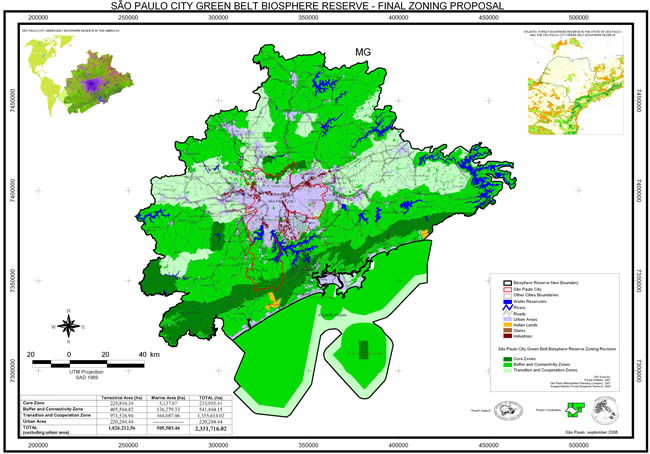
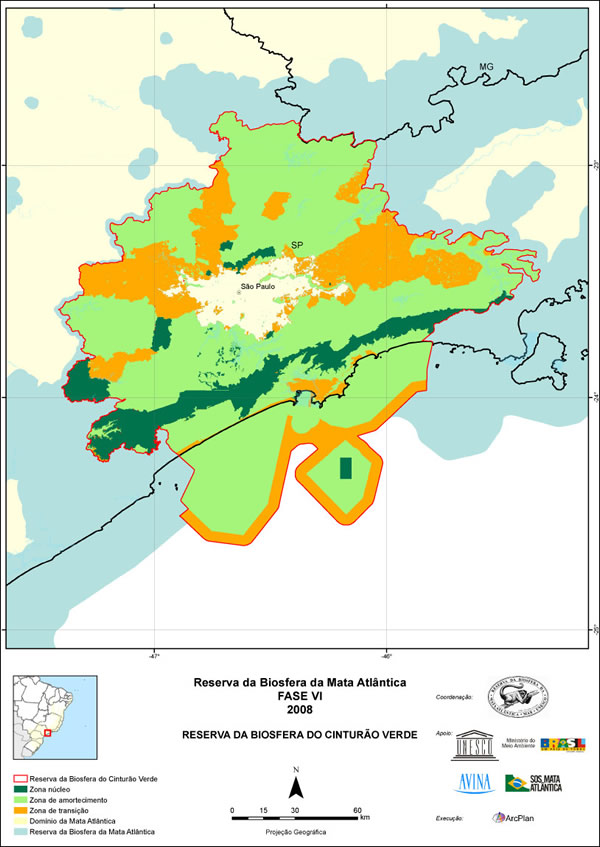
Conforme descrito anteriormente, a maior parte da área marinha é classificada na categoria de Zona de Amortecimento, com adicional de Zona Núcleo e Transição conforme ilustrado no anexo 11.
4.7 Base de dados e referências
No processo de revisão do zoneamento da RBCV, a base de dados do Instituto Florestal do Estado de São Paulo foi fornecida através do Inventário Florestal da Vegetação Natural do Estado de São Paulo, desenvolvido no ano de 2005.
Complementar a esta base de dados, a EMPLASA – Companhia de Planejamento Metropolitano de São Paulo disponibilizou parte do banco de dados referentes aos indicadores metropolitanos de São Paulo e, a base de dados da ArcPlan Geoprocessamento no apoio a complementação aos zoneamentos de ambas as Reservas RBCV e RBMA.
O Software utilizado foi ArcView versões 3.2 e 9.2 da empresa ESRI.
4.8 O processo de revisão do zoneamento da RBCV - considerações finais
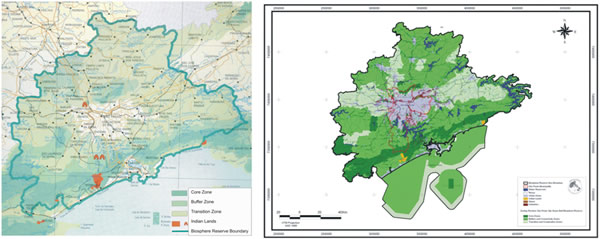
Os seguintes mapas comparam as zonas da RBCV, limites e valores antes e após o processo de revisão FIGURA 1:

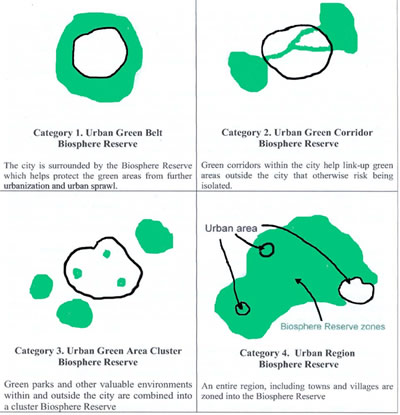
Em termos de representação e configuração, a Reserva da Biosfera do Cinturão Verde da Cidade São Paulo é agora um bom exemplo de pelo menos 3 em 4 Reservas da Biosfera Urbana inseridas nas categorias propostas pelo Grupo MaB Urbano. Como pode ser visto a partir da figura abaixo, a nova configuração da RBCV, além do cinturão verde em si, contém agora corredores ecológicos e de biodiversidade e fragmentos florestais conectados.
Figura 2 – Possíveis categorias de reservas de biosfera urbana
4.9 Validação do Processo de Revisão do Zoneamento da RBCV
O processo de revisão do zoneamento passou por uma série de discussões participativas com estágios diferentes de discussões por parte dos interessados no processo, tendo sido oficialmente aprovado e/ou validados a nível local e nacional. Em síntese, as seguintes etapas fatos são dignos de nota:
4.9.1 O processo de revisão foi solicitado pela Reserva da Biosfera no Plano de Ação e aprovado pelo seu Conselho de Gestão em 2006.
4.9.2 O processo seguiu os procedimentos e critérios coerentes, um bom instrumento para inovações, fez um balanço das mais recentes discussões levantadas por vários grupos internacionais e de domínios (por exemplo, o Millenium Ecosystem Assessment, o Grupo MaB Urbano, o Congresso Mundial de Madri e seus resultados), utilizando bases de dados e informações confiáveis e submetidos a revisão externa mais de uma vez.
4.9.3 Considerando a transparência dos processos, com objetivos claros e coerentes seguidos de orientações, a revisão do zoneamento da RBCV permaneceu aberta e flexível ao longo do período de trabalho técnico e incorporou a maioria das sugestões que surgiram ao longo das discussões.
4.9.4 O processo sofreu (e foi moldado) pelo Bureau da Reserva da Biosfera do Cinturão Verde da Cidade de São Paulo por meio de várias discussões e foi formalmente aprovado pelo seu Conselho de Gestão em 13 de agosto de 2008. É importante observar que a composição do Conselho de Gestão da RBCV é muito representativo pela diversidade e pela quantidade de interessados. A revisão do zoneamento incorporou os seus pontos de vista, opiniões e interesses socioambientais.
A carta no ANEXO 15 oficializa o novo zoneamento e os limites no âmbito do Sistema de Gestão da Reserva da Biosfera do Cinturão Verde da Cidade de São Paulo.
4.9.5 O processo de revisão do zoneamento tem sido amplamente discutido com a Reserva da Biosfera da Mata Atlântica e aprovado pelo Conselho Nacional e equipe técnica.
4.9.6 Finalmente, a revisão do zoneamento foi aprovada pelo Comitê Brasileiro MaB, juntamente com a Reserva da Biosfera da Mata Atlântica em uma reunião ocorrida em 28 de agosto de 2008. A carta de aprovação é delimitada no Anexo 2 do Documento de Revisão do Zoneamento da Reserva da Biosfera da Mata Atlântica (cartas de apoio à Revisão do Zoneamento da Reserva da Biosfera da Mata Atlântica - Fase VI).
4.10 Próximos Passos e Comentários Finais
O documento que está atualmente a ser submetidos à aprovação do Comitê Consultivo MaB, descreve conceitualmente, legalmente e institucionalmente melhorias do zoneamento desde a declaração oficial da Reserva da Biosfera do Cinturão Verde da Cidade de São Paulo em 1993.
Do atual zoneamento, é esperado que cada vez mais tomadores e gestores regionais se inspirem, além de todas as partes interessadas em promover os domínios da "gestão integrada e sustentável, podendo ser de grande valor para outras Reservas da Biosfera da Rede Mundial no enfrentamento dos desafios de conciliar o dinâmico processo de urbanização a conservação/preservação ambiental.
De fato, o Plano de Ação de Madri coloca a urbanização como um dos principais desafios emergentes do mundo e destaca o "papel das Reservas de Biosfera como instrumentos a enfrentar estes desafios". Na sua seção A.3, "A urbanização é o principal eixo de pressão dos ecossistemas ameaçados", o plano menciona expressamente que "Um certo número de áreas urbanas estão sendo estudados, ou querem tentar aplicar os princípios de uma a Reserva da Biosfera dentro de suas jurisdições, com a intenção de utilizar o conceito como um poderoso instrumento de planejamento e gestão integrada do território no desenvolvimento urbano sustentável ".
Nesse sentido, ambas as metodologias de zoneamento das Reservas Biosfera, sob pesada influência urbana e da nova geração de Reservas Biosfera Urbana, terão uma importância crescente para a Rede Mundial de RBs durante a fase de execução do Plano de Ação de Madri (2008-2013) e mais além.
Como mencionado anteriormente neste documento, a metodologia desenvolvida durante esta revisão é apenas o ponto de partida de um processo em que a atual fase é uma fase precoce. A intenção da RBCV em abordar a escala municipal no seu zoneamento, trazendo para a realidade de cada um dos seus 78 municípios é uma tarefa muito complexa ser realizada. Com esta iniciativa, a RBCV visa não apenas a reconhecer projetos e planejamentos locais e enquadramentos legais, mas, ser uma plataforma integradora de uma série de tomadores de decisão e planejadores municipais na adoção de políticas públicas inovadoras.
Além disso, em uma escala mais ampla como o caso da Região Metropolitana São Paulo, está em avançado processo de reestruturação através da criação de um Conselho e uma Agência para a tão desejada gestão regional integrada; onda a ferramenta Reserva da Biosfera é digna de ser um instrumento a ser aplicado para a execução de movimentos regionais e integrados às políticas socioambientais.
4.11 Lista de anexos
Anexo 1 - Sistema de Gestão da Reserva da Biosfera do Cinturão Verde da Cidade São Paulo
Anexo 2 - "Reservas Biosfera Urbana, no âmbito do Quadro Legal e da Estratégia de Sevilha a Rede Mundial de Reservas Biosfera" (UNESCO, 2003) e "Urbano Biosfera Reservas - Um Relatório do Grupo MAB Urbana" (UNESCO, 2006) .
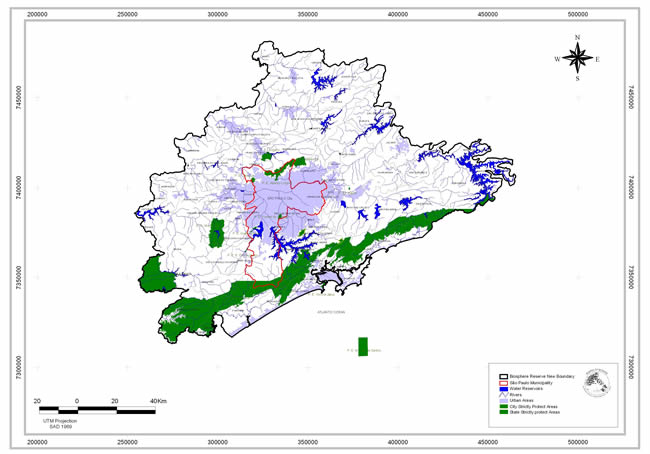
Anexo 3 – Áreas de Proteção Integral (Parques federais, estaduais e municipais, estações ecológicas, reservas biológicas, monumentos naturais, refúgios de vida silvestre e as Reservas Particulares do Patrimônio Natural – RPPN)
Anexo 4 - Zonas de Vida Silvestre das Áreas de Proteção Ambiental – APAs
Anexo 5 - Áreas de Proteção Ambiental – APAs (estaduais e municipais)
Anexo 6 - Áreas de Proteção aos Mananciais (exceto áreas urbanizadas)
Anexo 7 – Florestas Maduras
Anexo 8 - Corredor Ecológico e de Biodiversidade entre os Parques Estaduais da Cantareira e Juquery
Anexo 9 - Rede de parques e áreas verdes dos municípios de São Paulo e Santo André
Anexo 10 - Zona Especial de Interesse Ambiental (referindo-se a mata ciliar áreas de conservação e recuperação) do município de Santo André
Anexo 11 - Áreas prioritárias para conservação marinha
Anexo 12 - As áreas restantes, com exceção das grandes manchas urbanas
Anexo 13 – Alterações dos limites da RBCV - Face Leste
Anexo 14 – Alterações dos Limites da RBCV - Face Oeste
Anexo 15 – Ofício do Conselho de Gestão da RBCV reconhecendo e aprovando o processo de Revisão do Zoneamento da Reserva da Biosfera do Cinturão Verde da Cidade São Paulo, 2008.
Anexo 16 – Revisão do Zoneamento da Reserva da Biosfera do Cinturão Verde da Cidade de São Paulo – Versão Final
ANEXOS
RBCV-SP ANEXO 1
RBCV-SP ANEXO 2
Reservas Biosfera Urbana, no âmbito do Quadro Legal e da Estratégia de Sevilha a Rede Mundial de Reservas Biosfera" (UNESCO, 2003)
"Urbano Biosfera Reservas - Um Relatório do Grupo MAB Urbana" (UNESCO, 2006)
SC-06/CONF.202/INF.6
Paris, 10 October 2006
English only
UNITED NATIONS EDUCATIONAL, SCIENTIFIC AND CULTURAL ORGANIZATION
International Coordinating Council of the Man and the Biosphere (MAB) Programme
Nineteenth Session
UNESCO Headquarters, Paris, Room IV (Fontenoy Building)
23-27 October 2006
Urban Biosphere Reserves
A Report of the MAB Urban Group
I. Introduction
1. This report represents the consensus opinion of the UNESCO-MAB Urban Group (referred to as the Urban Group hereafter) and is derived from discussions over the Internet and at international meetings and conferences including: “Urban Biosphere and Society” in New York (2003), “Life in the Urban Landscape” in Gothenburg (2005), and the workshop on Biodiversity and Urban Areas in Paris (2005). The report includes a discussion on suggested guidelines/criteria to help the development of Urban Biosphere Reserves (UBRs); it also notes the relevance of the current concept to the World Network of Biosphere Reserves (WNBR) as a whole (it might be argued that the São Paulo City Greenbelt Biosphere Reserve is a UBR already). With the increased rate of urbanization around the globe, many existing Biosphere Reserves will have no alternative but to incorporate urban landscapes and respond to urbanization as a dominant driver of change. The report then concludes that inclusion of urban areas within the WNBR may ultimately benefit the entire network. In view of increased human domination of ecosystems worldwide the Seville Strategy and Statutory Framework may be ready for revision in order to remain relevant.
II. Urban Biosphere Reserves. Why? And how?
The context
2. Today half of the world’s population lives in urban landscapes, a proportion increasing to two-thirds within 50 years. The rapid increase of large cities in the developing world and the transformation of urban landscapes in the developed world represent one of the greatest challenges to ensure basic human welfare and a viable global environment. In 2030 it is estimated that more than two billion people will be living in urban slums with limited access to basic services, limited participation in decision-making processes and facing extreme vulnerability to natural disasters. Urban landscapes probably represent the most complex mosaic of land-cover and multiple land uses of any landscape. As such, urban landscapes provide important large-scale probing experiments of the effects of global change on ecosystems, since for instance significant warming and increased nitrogen deposition are already prevalent and because they provide extreme, visible and measurable examples of human domination of ecosystem processes. Urbanization places increased pressures on vulnerable ecosystems but urban landscapes are also sources of knowledge, resources and innovations offering solutions for humans and the environment.
3. The Millennium Ecosystem Assessment (MA) recently identified urbanization and urban landscapes as a priority area for a viable, sustainable strategy requiring a much deeper understanding of processes and increased capacity to adapt to the urbanization process. The MA is based on analyses of ecosystem services defined as the benefits people obtain from ecosystems including: provisioning services (the products obtained from ecosystems); regulating services (the benefits obtained from the regulation of ecosystem processes); cultural services (the non-material benefits people obtain from ecosystems through spiritual enrichment, cognitive development, reflection, recreation, and aesthetic experiences); and the supporting services (those that are necessary for the production of all other ecosystem services). The MA-report stresses that in urban areas, green spaces and vegetation may provide a number of these services but the diversity and complexity of processes demand innovative ways to manage and maintain these services. The MA represents an extremely rich and important source of information and data for guiding policies on ecosystem- and urban landscape-management and presents an opportunity for the MAB Programme to incorporate its findings and recommendations in the next generation of guidelines for Biosphere Reserves, including UBRs. In turn, this would help to integrate the MA results into local and regional policies for land use and ecosystem management.
4. Efforts in this direction are already taking place in the São Paulo City Green Belt Biosphere Reserve and in the Kristianstad Vattenrike Biosphere Reserve (Sweden), both of which have participated in the Sub-global MA process. More than just examples of MA and the WNBR interacting, findings of these local assessments will be extremely valuable for the integrated management of these BRs and, ultimately, for inspiring others to further explore the connections between ecosystem services and human well-being in their urban, peri-urban or rural management frameworks.
III. Suggested features of Urban Biosphere Reserves
5. It is clear to the Group that in order to be meaningful, a UBR should add tangible benefits to an urban area such as a sound manageable structure and not just add another administrative layer. To do that, the MAB community should not simply accept and ‘tolerate’ urban landscapes as functioning ecosystems worthy of BR designation but explicitly recognize the unique contributions such landscapes may make to the three functions characterising the Biosphere Reserve concept: i.e. conservation, sustainable development, and research and education.
6. In looking at features /characteristics for UBRs, the MAB Urban Group did not simply look at how urban landscapes could qualify for BR designation as perceived today but also how the concept could grow, enrich itself and become a widely accepted tool for land use management.
7. The MAB Urban Group thus considered features that would allow urban landscapes to both qualify and benefit as UBRs. These included:
• recognition of the value and services provided by urban nature in an urban context;
• the existence and implementation of a plan for the conservation of urban
biodiversity, as well as ecosystem services;
• demonstrable local interest in nature conservation and commitment by local and /or regional governments to mainstream environmental issues into development and social policies;
• innovative practices with biodiversity benefits such as green roofs, energy and water policies, waste management and urban restoration;
• research and education capacities to investigate processes and inform urban policies;
• an adequate scale for ecosystem management with attention to temporal dynamics;
• consideration of environmental justice elements such as the promotion of imports/consumption of eco-labelled goods and the use of fair trading arrangements;
• designating ‘zones of cooperation’ in collaboration with other cities, rural areas or biosphere reserves for cooperation on sustainable development;
• using alternatives to the traditional zoning system, such as the “thematic area” system used in Kristianstad BR;
• exploring practices and models for reducing social exclusion in urban and periurban areas through environmental conservation actions.
8. Following on from the issue of an UBR’s impact on the wider world is the question of how it should relate to the rural areas that surround it. Specifically, how much of the countryside surrounding the city should be included in an Urban Biosphere Reserve? Some existing cities, such as Rome contain large rural areas within the jurisdiction of the city authorities, and in the case of Rome these rural areas are being encouraged to produce sustainably-farmed foodstuff for the city. In the case of Kristianstad Vattenrike, the wetlands surrounding and sustaining the urban area provide the link and the natural network that connect construction with the natural environment.
9. A similar situation can be found in the São Paulo City Green Belt: most of the relevant remaining ecosystems that provide essential services to 23 million people are peri-urban or surrounding ones and extend to an area that goes much beyond the built-up environment. In view of these examples, the Group concluded that it may not be possible to set criteria for the extent of rural areas to be incorporated into an UBR, but that candidate UBRs should be requested to explicitly identify and justify the inclusion of rural areas in their proposed zonation.
10. There was also a debate about whether part of an urban area could become an UBR whilst other parts of the same conurbation were not subject to designation. There was consensus that the entire conurbation should be included in an UBR and that it would impose unacceptably artificial boundaries on the urban system to allow parts of the conurbation to be excluded.
11. The question of how large a settlement should be before it qualifies for consideration as an UBR provoked considerable debate. Some suggested that only very large cities should qualify while others noted that small to medium sized cities often exhibit problems of urbanization and exemplify solutions, which would be applicable on a global scale. It was further noted that many smaller cities are already part of existing BRs even though the focus of many of these BRs is, and is likely to remain, upon biodiversity outside these settlements. Clearly, an UBR must have some focus on urban issues to add value to the work of the WNBR. It has therefore been suggested that the focus of an UBR should be on human settlements and the value of biodiversity to enhance their quality of life, and not solely on biodiversity, which may be the focus of the more traditional, rural BRs. It is postulated that this could be the main difference between UBRs and existing BRs.
12. Finally, it was fairly obvious to the Group that urban landscapes, no matter how much biodiversity value they may acquire through BR designation, would primarily continue to serve other functions besides nature conservation. Even with regards to nature management within defined urban landscapes, the group suggested that an UBR should use the existing wide variety of designations, protected areas and plans within a city as its components.
13. Inevitably this process will require thoroughly considered:
a. administrative organization (in which all stakeholders take part);
b. funding arrangements (to assure the functioning of the administrative organization);
c. communications/education strategies (to inform and engage the resident population).
These strategies should be targeted at specific levels for individual audiences such as for councillors, ratepayers, school children, etc.;
d. cooperation plans (to enable conflict resolution). It will be important to address the levels of responsibility (environmental, social and economic) within the UBR through such plans.
14. It was suggested that the most important issue might be the settlement’s ability to demonstrate innovation in integrating urban lifestyles in the natural environment and successful conservation of biodiversity. Combining this with the requirements of criterion 4 of article 4 of the Statutory Framework that Biosphere Reserves should be of an appropriate size to serve the three functions of a Biosphere Reserve ought to enable a judgement to be made about a settlement’s eligibility for accession to the WNBR.
15. There has been a strong debate on the question of whether only urban areas with exceptionally high biodiversity should qualify as UBRs. Although the main focus of an UBR should not be on biodiversity per se (as noted above), they should include a system of natural or near-natural open spaces that can fulfil the function of conservation and to prove the value of biodiversity to city livelihoods. Cape Town is an example of a conurbation that includes substantial areas of extreme biodiversity value, being situated in the Cape Floral Kingdom. In Western Europe, the flora of the major conurbations can be shown to have greater similarities with that of other conurbations than with the countryside surrounding any particular conurbation. In addition to acting as host areas for existing ecosystems and biotopes, urban areas are developing distinct ecological associations and habitats of their own. For example, one of the United Kingdom’s most bio diverse sites is on an abandoned industrial development site on the Thames estuary near London. In Brazil, not only the São Paulo City Green Belt but also the entire Mata Atlântica BR systems encompass a number of small, medium and mega cities where inner and surrounding ecosystems are of extreme biological diversity. Criterion 2 of Article 4 of the Statutory Framework requires that BRs be of significance for biological diversity conservation.
IV. Urban Biosphere Reserves – implications for the World Network and a suggested framework for future research
16. The Urban Group operated on the premises that cities are positive assets and not simply the source of problems to be solved. It is noted that as well as consuming ‘tangible’ resources (food, fuel, building materials), cities produce ‘intangible’ products such as knowledge, innovation and art. The cultural identity and distinctiveness of a city comes from more than just its buildings and open spaces, it also comes from the unique history and traditions of its peoples including foods and values accorded to different flora and fauna.
17. This has raised the question of how UBRs might relate to World Heritage Sites. It is suggested that further work might usefully be done on this issue.
18. The Urban Group suggests that MAB consider including Biosphere Reserves with significant urban components into the World Network. Consideration of UBR criteria has led the Urban Group to discuss at least one issue, that of culture, and its place in Biosphere Reserves, upon which there is little guidance in the Statutory Framework and Seville Strategy. In Rome, the most highly bio diverse sites tend to be clustered around the oldest part of the city in the sites with greatest archaeological – and cultural – value. In Cape Town it might be argued that sites with outstanding contemporary cultural value do not coincide with biodiversity hotspots. The Seville Strategy Goal I is to use Biosphere Reserves to conserve natural and cultural diversity. This seems to clearly imply that there is a role for inclusion of cultural practices in the perception and management of natural areas in cities such as the exotic vs. native species debate. However, there is little guidance in the Strategy about what this actually means in terms of land use and zonation.
19. The Urban Biosphere and Society conference in New York in 2003 made three recommendations for the elaboration of the functions of BRs that would be required if the World Network were to admit sites with a large urban component. These focus even more intently on the human issues that underpin the critical relationship between people and nature in urban areas:
1. The conservation function, which traditionally covers protection of biodiversity against human intervention, should be extended to cover urban natural and cultural diversity such as community gardens, urban agriculture, and the relationship between immigration and the introduction of exotics in urban ecosystems;
2. The development function should be made more inclusive to introduce the idea of equity of access to urban environmental goods and services such as clean air, clean water, safe environment, and green spaces and environmental education;
3. The logistics function, which covers education and research, should look into education as a tool for self-reliance and empowerment. Outreach should include an examination of the ecological footprint of urban lifestyles and consumption patterns, and it should also contribute to making urban dwellers responsible stewards of the planet.
20. The MAB Urban Group strongly suggested that further research within the MAB program should be conducted on how the functional and spatial components of the BR concept could contribute to building a sustainable development ethic and governance regime inside and outside the World Network. Urban landscapes, whether they become fully fledged BRs or not, could be considered as sites of choice for such investigations. This would greatly contribute to mainstreaming the BR concept into sustainable development initiatives with a strong education and research component.
21. Some of these investigations and research could be conducted in conjunction with the Stockholm MISTRA Institute (see SC-06/CONF.202/INF.7 - Urban Policy and Research: MAB and the Stockholm MISTRA Institute) which has among its four cross-cutting research components two that have a direct relevance to BRs and urban landscapes: (1) The Urban social-ecological systems and globalization; and (2) adaptive governance of dynamic landscapes.
22. For some 30 years, the activity of WNBR has helped scientists and decision makers to better understand how human activity affects a variety of ecosystems, and individual BRs have proven to be successful laboratories for integrating development and conservation policies.
23. In the 12 years since the Seville Strategy was prepared, urban areas have expanded to a point where no policy today contemplates “stemming rural exodus” as they did twenty years ago. The impact of urban areas is not limited to their immediate hinterlands. Though ecological footprints are measured in hectares, physical impacts made by an urban area are distributed around the world. In view of this rapid urbanization, the Seville Strategy and Statutory Framework, in their present forms no longer provide sufficient guidance for the expansion/management of the WNBR. Therefore, if the BR concept is to remain a useful tool for understanding the effects of human activity on ecosystems and mitigating negative impacts, a revision of The Seville Strategy & the Statutory Framework of the World Network of Biosphere Reserves is required.
24. One component of such a revision must be the development of adequate criteria and Implementation Indicators for urban areas as BRs. Another is to provide sufficient guidance to existing BRs on how to integrate urban development issues – be they direct or indirect – into their management plans. Finally, better linkages with other global networks are essential in order for the WNBR to benefit from their experience as well as to ensure that the different networks remain complementary rather than competitive.
25. It is further suggested that UBRs require their own evaluation system. As a new component of the WNBR, operating in areas with a great diversity of stakeholders, it will be important to be able to demonstrate to all stakeholders that their UBR is adding value to that area, rather than just adding another layer of institutional complexity. It is therefore suggested that an evaluation system be developed specifically for UBRs, rather than relying on the existing periodic review form. In this regard, it is worthy citing the São Paulo City Green Belt BR which developed a set of urban-specific Implementation Indicators in addition to those contained in the Seville Strategy on the occasion of its preliminary evaluation in 2005.
V. Key recommended actions that could be taken in the light of this information note:
26. The Urban Group recommends that the International Coordinating Committee consider:
• Renewing the mandate of the Urban Group to further pursue the questions posed in this report;
• Ensuring that the above issues receive sufficient attention in future MAB research programmes;
• Conducting some of the suggested investigations and research in conjunction with the Stockholm MISTRA Institute;
• Undertaking a survey of BR managers to identify how urban challenges are affecting their work, across the WNBR;
• Convening a meeting of experts to update The Seville Strategy & the StatutoryFramework of the World Network of Biosphere Reserves;
• Incorporating the findings and recommendations of the Millennium Ecosystem Assessment (MA) in the next generation of guidelines for Biosphere Reserves, including UBRs.
MAB Urban Group
Draft June 2003
Urban Biosphere Reserves in the context of the Statutory Framework and the
Seville Strategy for the World Network of Biosphere Reserves
1. The present document outlines the preliminary considerations by the MAB Urban Group concerning Urban Biosphere Reserves in the context of the Statutory Framework and the Seville Strategy for the World Network Biosphere Reserves.
2. Although a good number of existing Biosphere Reserves actually include cities and towns, and/or are adjacent to major urban areas, the Biosphere Reserve Advisory Committee and the MAB Bureau have likely yet to consider more clearly urban-oriented Biosphere Reserve nominations. Such nominations could actually be a question of time (cities known to consider nominations include Cape Town, New York, Rome and Stockholm).
3. The reflections on this topic are therefore intended to facilitate the deliberations of the Biosphere Reserve Advisory Committee and the MAB Bureau in the eventuality of such applications actually being submitted. The recommendations contained in the document are however not final as far as they represent ‘work in progress’. A more definitive text will be prepared following the meeting of the MAB Bureau 8-11 July 2003, and the “Urban Biosphere & Society: Partnership of Cities Conference”, 28-31 October 2003, in New York.
4. The document is divided into four parts: the first section seeks to define the notion of Urban Biosphere Reserves, the second part addressed the question if Urban Biosphere Reserves are compatible with the Statutory Framework for Biosphere Reserves, in the third section we try to answer the question if Urban Biosphere Reserves would be a welcome addition to the World Network, section four contains the conclusions and recommendations.
I. Defining ‘Urban Biosphere Reserves’
5. Before assessing the extent to which Urban Biosphere Reserves are compatible with the Statutory Framework, it would seem necessary to seek to establish a working definition of the notion of an Urban Biosphere Reserve. A standard definition of an urban area is: “a geographical area constituting a city or town”. A simplistic proposal would then be to say that an Urban Biosphere Reserve is a Biosphere Reserve constituting a city or town. However, in the discussions now going on in a number of cities around the world, the idea has never been to restrict an Urban Biosphere Reserve only to the urban areas (i.e. the cities or towns), but to take a regional perspective integrating urban areas and their hinterlands. Furthermore, the mere existence of a city or a town in a Biosphere Reserve is not sufficient to call it an Urban Biosphere Reserve (if it were, a large number of existing Biosphere Reserves could be classed as Urban Biosphere Reserves). The issue is then that of defining the relative importance of the urban elements in the Biosphere Reserve.
6. The ‘relative importance’ could possibly be assessed as a function of several measurable factors in the Biosphere Reserve, e.g. percentage of urban land cover, rate of urbanization and urban sprawl, distance to major urban areas, percentage of people living in urban areas compared to the country side, impacts of urban areas and the urban population on the Biosphere Reserves etc).
7. The underlying key objectives for which the Biosphere Reserve was established, e.g. conservation of urban biodiversity, promoting sustainable urban development and reduced urban foot-prints, city networking etc., could also be defining characteristics of an Urban Biosphere Reserve. It is not, however, the purpose here to seek to establish any more rigid indictors for assessing Urban Biosphere Reserves (that could be the subject for a separate paper).
8. A possible working definition of an Urban Biosphere Reserve based on the above considerations could therefore be as follows:
- Urban Biosphere Reserve: a Biosphere Reserve characterized by important urban areas within or adjacent to its boundaries where the natural, socio-economic and cultural environments are shaped by urban influences and pressures, and set-up and managed to mitigate these pressures for improved urban and regional sustainability.
Possible categories of Urban Biosphere Reserves
9. Depending on their zonation pattern, different categories of Urban Biosphere Reserves could be envisioned, such as Urban Green Belt Biosphere Reserves, Urban Green Corridor Biosphere Reserves, Urban Green Area Cluster Biosphere Reserves and Urban Region Biosphere Reserves (see Fig 1).
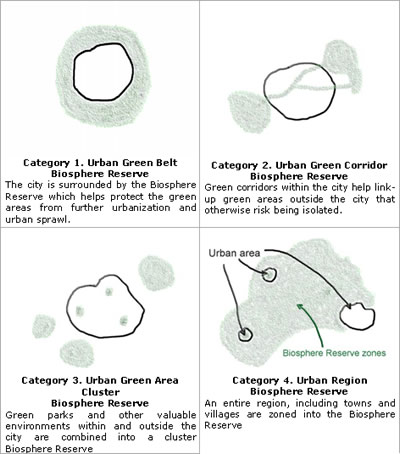
Fig 1. Examples of possible categories of Urban Biosphere Reserves
10. Combinations of these categories are of course possible, or even likely. The distribution of the three different Biosphere Reserve zones (i.e. core, buffer and transition areas) adds to the large number of possible combinations.
II. Urban Biosphere Reserves in the context of the Statutory Framework of the World Network of Biosphere Reserves
11. The Statutory Framework of the World Network of Biosphere Reserves (the ‘Framework’) includes an Introduction and 10 Articles. It is the document that guides the Advisory Committee on Biosphere Reserves and the MAB Council and its Bureau when considering Biosphere Reserve nominations. We will here address the question if Urban Biosphere Reserves as defined and categorized above are compatible with the relevant paragraphs of the Framework.
12. It is stated in the Framework’s introduction that “Within UNESCO's Man and the Biosphere (MAB) programme, biosphere reserves are established to promote and demonstrate a balanced relationship between humans and the biosphere”. Urban areas and regions will more than often not exemplify such a relationship. On the other hand, Urban Biosphere Reserves could be important to promote them. Also, Urban Biosphere Reserves could demonstrate examples of balanced relationship between humans and the biosphere reserves in certain sectors, although it may not contribute to the full range of human-biosphere interactions.
13. The Introduction ends with the proposal that “States are encouraged to elaborate and implement national criteria for biosphere reserves which take into account the special conditions of the State concerned”. States interested in elaborating criteria for Urban Biosphere Reserves would therefore seem to be encouraged to do so.
14. Article 1 defines Biosphere Reserves as “areas of terrestrial and coastal/marine ecosystems or a combination thereof, which are internationally recognized within the framework of UNESCO's programme on Man and the Biosphere (MAB), in accordance with the present Statutory Framework”. The notion of urban ecosystems was pioneered by MAB and Urban Biosphere Reserves will typically consist of a rich mosaic of terrestrial and coastal ecosystems. The definition, however, is a very general one more aiming at ensuring that sites labelled as Biosphere Reserves are those that are recognized by MAB as such rather than to define their features in detail.
15. Article 3 in the Framework sets out the three major functions of Biosphere Reserves: “In combining the three functions below, biosphere reserves should strive to be sites of excellence to explore and demonstrate approaches to conservation and sustainable development on a regional scale:
(i) conservation - contribute to the conservation of landscapes, ecosystems, species and genetic variation;
(ii) development - foster economic and human development which is socio-culturally and ecologically sustainable;
(iii) logistic support - support for demonstration projects, environmental education and training, research and monitoring related to local, regional, national and global issues of conservation and sustainable development.
16. The first general remark that could be made here is that it actually would be quite difficult to perceive how Biosphere Reserves that do not include urban areas possibly could demonstrate approaches to conservation and sustainable development on a regional scale. Regions without urban areas, or perhaps without people, would not be good examples of a ‘balanced relationship between humans and the biosphere’ (Introduction). If it is agreed that sustainable development cannot be achieved without sustainable urban development, again, it will be difficult to rule out Urban Biosphere Reserves.
17. Urban Biosphere Reserves could certainly contribute to the conservation of landscapes and biodiversity of high importance for a large number of people. Both locally, regionally and globally (through reduced urban foot prints). They would also form important platforms for fostering development along more sustainable lines. Urban areas are typically cast in the light of their negative impacts, however, it should of course not be forgotten that cities and towns are critical in terms of also providing a number of benefits, such as income and job opportunities, markets, health and educational facilities without which several Biosphere Reserves, and society at large, actually would not be fully functional or sustainable. Finally, Urban Biosphere Reserves could provide logistic support for education, public awareness and research on critical issues linked to conservation and sustainable urban development.
18. It is useful to recognize here that an Urban Biosphere Reserve (or any Biosphere Reserve for that matter) never is synonymous to the city, town or region where it is situated - it is merely one additional institutional structure among a myriad of human institutions (albeit an important one!). Therefore, an Urban Biosphere Reserve cannot and should not be held ‘accountable’ for all facets of man-environment interactions within its boundaries. Being associated with an unsustainable urban area should therefore not automatically be seen to imply that the Biosphere Reserve does not, or could not fulfil its functions.
19. The Framework’s Article 4 sets out the general criteria for an area to be qualified for designation as a Biosphere Reserve. We will look at the seven criteria one by one:
1. It should encompass a mosaic of ecological systems representative of major biogeographic regions, including a gradation of human interventions.
Needless to say, perhaps more than any other reserves, Urban Biosphere Reserves will contain a broad gradient of human interventions and a rich mosaic of ecological systems.
2. It should be of significance for biological diversity conservation.
Urban areas include important, sometimes unique biodiversity. In addition, biodiversity in urban areas tend to be essential for the welfare of its inhabitants (food, climate regulation, water catchments, recreation etc).
3. It should provide an opportunity to explore and demonstrate approaches to sustainable development on a regional scale.
More than perhaps any other types of reserves, Urban Biosphere Reserves would be important tools to address sustainable development on a regional scale by integrating urban areas which often are at the centre of the sustainability debate.
4. It should have an appropriate size to serve the three functions of biosphere reserves, as set out in Article 3.
There are no restrictions as such as to have big an Urban Biosphere Reserve could be. An appropriate size could therefore usually be envisaged involving urban areas and their hinterlands.
5. It should include these functions, through appropriate zonation, recognizing:
(a) a legally constituted core area or areas devoted to long-term protection, according to the conservation objectives of the biosphere reserve, and of sufficient size to meet these objectives;
As already discussed, an Urban Biosphere Reserve could be set-up in a number of ways. An Urban Green Corridor Biosphere Reserve (category 2), for example, could include core areas within the urban area (e.g. park areas, rivers and lakes). These areas can be the subject to legal protection and of a sufficient size to ensure that the conservation objectives are met.
(b) a buffer zone or zones clearly identified and surrounding or contiguous to the core area or areas, where only activities compatible with the conservation objectives can take place;
Buffer zones may require some innovative thinking in the urban context. For example, residential areas could provide buffer zone protection for rivers and lakes within the city provided they are equipped with sound waste water facilities etc. Furthermore, polluting industrial activities not compatible with the conservation objectives could be avoided in such areas (perhaps to the benefit of human health as well).
(c) an outer transition area where sustainable resource management practices are promoted and developed.
There are no limitations to the possibilities an Urban Biosphere Reserve could provide in terms of promoting and developing sustainable resources management practices in sectors such as agriculture, forestry, recreation, water, energy, transport, housing and waste management. Of minor importance here is perhaps the fact that the transition areas may not always be the outer areas in an Urban Biosphere Reserve, rather they could find themselves surrounded by buffer zones and core areas.
6. Organizational arrangements should be provided for the involvement and participation of a suitable range of inter alia public authorities, local communities and private interests in the design and carrying out the functions of a biosphere reserve.
Key public and private stake holders are concentrated to the urban areas which will facilitate their involvement and participation in the design and operations of an Urban Biosphere Reserve. Although the politics of establishing and managing an Urban Biosphere Reserve could be expected to be complex, the benefits of such a process could be enormous in terms of bringing stakeholders aboard on a cooperation platform for regional sustainability that typically will not have existed before.
7. In addition, provisions should be made for:
(a) mechanisms to manage human use and activities in the buffer zone or zones;
Urban areas have often already established mechanisms in place to oversee and manage economic and other human activities.
(b) a management policy or plan for the area as a biosphere reserve;
An increasing number of cities around the world have developed local Agenda 21 initiatives and have well established (more or less well implemented) plans and policies covering most facets of urban life. These can in many instances form an effective basis for an Urban Biosphere Reserve policy which in addition, however, also would have to extend to the hinterlands. The fact that an Urban Biosphere Reserve would seek to bridge the often conflicting interests between cities and their hinterlands is what makes it so attractive and potentially powerful.
c) a designated authority or mechanism to implement this policy or plan;
This is a of course a key point for any successful Biosphere Reserve. It will however in many instances be a tough challenge for an Urban Biosphere Reserve to muster the power and authority to ensure the implementation of a comprehensive and ambitious policy or plan that would touch on fundamental urban management issues. There are no fix prescriptions for how a Biosphere as an institution can or should be setup to ensure implementation. Legislation, political, public and financial support are all important ingredients for success. Increasingly, the true strength of Biosphere Reserves might lie in their ability to produce sustainable economic benefits spurred by a shared vision among key stakeholders of the region as a space for sustainable development cooperation.
(d) programmes for research, monitoring, education and training.
Easy access to universities, research facilities, schools and education centres will help ensure that Urban Biosphere Reserves can establish strong programmes for research, monitoring, education and training. Urban Biosphere Reserves could also help promote the establishment of new and innovative training centres for education for sustainable development at different levels.
20. The above discussion is but a short, partly theoretical analysis of the extent to which Urban Biosphere Reserves are or would be compatible with the Framework. The conclusion at this point in time, however is that Urban Biosphere Reserves are compatible with the Framework.
III. Urban Biosphere Reserves - a welcome addition to the World Network?
21. It is one thing to suggest that Urban Biosphere Reserve would be compatible with the Statutory Framework, but are they a welcome contribution to the World Network? One authority on the issue of Biosphere Reserves for the 21st Century is of course the Seville Strategy (the ‘Strategy’). Drawn up by 400 experts from 102 countries and 15 international and regional organizations in Seville in March 1995, the Strategy seeks to identify “the specific role of biosphere reserves in developing a new vision of the relationship between conservation and development” together with a series if recommendations for developing effective Biosphere Reserves and for setting out the conditions for the appropriate functioning of the World Network of Biosphere Reserves. At its 13th session (12-16 June 1995), the MAB-ICC gave its strong support to the Seville Strategy.
22. Well, does the Strategy talk about Urban Biosphere Reserves? Not really, but it gets fairly close. Ten key directions were identified by the Seville Conference that formed the foundations for the Strategy. The second key direction is that Biosphere Reserves should be developed “that include a wide variety of environmental, biological, economic and cultural situations, going from largely undisturbed regions and spreading towards cities.” Exactly where this spread should be interrupted on its way towards the urban areas, if at all, is not specified leaving the question somewhat open.
23. In relation to the coverage of the World Network, it is however recommended (under Goal I) to “…establish, strengthen or extend biosphere reserves as necessary, giving special attention to fragmented habitats, threatened ecosystems, and fragile and vulnerable environments, both natural and cultural”. For many, this would seem to be an implicit call for Urban Biosphere Reserves.
24. Concerning the transition areas, the Strategy documents explains that it “may contain a variety of agricultural activities, settlements and other uses and in which local communities, management agencies, scientists, non-governmental organizations, cultural groups, economic interests and other stakeholders work together to manage and sustainably develop the area's resources”. This could also be interpreted as a support for Urban Biosphere Reserves (as far as the transition areas are concerned).
25. It is recommended under the Strategy’s Goal II (utilize Biosphere Reserves as models of land management and of approaches to sustainable development) to “establish, strengthen or extend biosphere reserves to include areas … where there are critical interactions between people and their environment (e.g. peri-urban areas, degraded rural areas, coastal areas, freshwater environments and wetlands)”. Peri-urban areas are mentioned as examples here, but the text again stops short of mentioning cities.
26. Although the Strategy includes a large number of recommendations, it modestly acknowledges that it is deliberately focused on a “few priorities”. This is one possible explanation to why the document is not more explicit on urban issues. Also, the focus on urban areas, urbanization and urban sprawl has become sharper since 1995.The Strategy might therefore have been more sensitive to the urban agenda had it been drafted today.
27. Another possible explanation is of course that Urban Biosphere Reserves were not seen as such a good idea, perhaps based on the concern that they somehow would stretch the Biosphere Reserve concept beyond recognition. If so, comfort could be drawn from the Strategy document that underscores that “In fact, one of the greatest strengths of the biosphere reserve concept has been the flexibility and creativity with which it has been realized in various situations.”
28. A parallel could possibly be drawn here to the World Heritage Convention, which successfully manages to cover such different entities as cultural and natural properties, recently extended to also cover cultural landscapes. This without eroding either the rationale for, or the usefulness of the Convention to its Member States. For the Convention, the connecting theme is that of conserving universal cultural values. For Biosphere Reserves, the connecting theme is contained in their three functions, i.e. conservation, development and logistics with sustainable development as a possible over-arching theme. It would seem only timely that if Member States proposed Urban Biosphere Reserves, they would be a welcome addition to the World Network.
IV. Conclusions and recommendations
29. Urban Biosphere Reserves as defined in this document would seem to be compatible with the Statutory Framework, and if not called for, at least not ruled out in the Seville Strategy. In view of the fact that urban areas are key players in the quest for sustainability, refusing Biosphere Reserve proposals simply because they includes urban areas would seem counterproductive.
RBCV-SP ANEXO 3
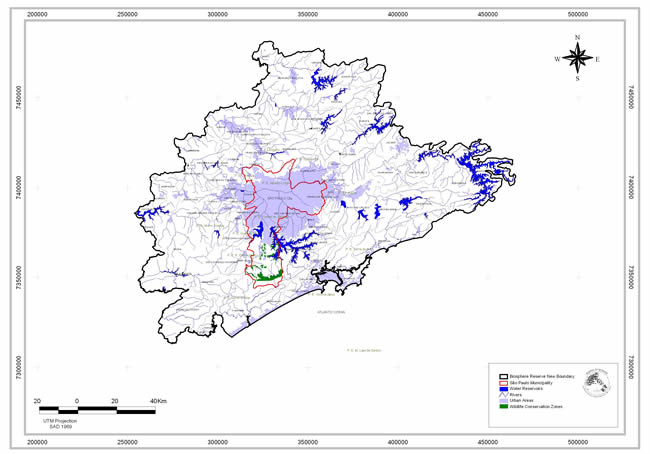
Áreas de Proteção Integral (Parques federais, estaduais e municipais, estações ecológicas, reservas biológicas, monumentos naturais, refúgios de vida silvestre e as Reservas Particulares do Patrimônio Natural – RPPN)
RBCV-SP ANEXO 4
Zonas de Vida Silvestre das Áreas de Proteção Ambiental – APAs
RBCV-SP ANEXO 5
Áreas de Proteção Ambiental – APAs (estaduais e municipais)
RBCV-SP ANEXO 6
Áreas de Proteção aos Mananciais (exceto áreas urbanizadas)
RBCV-SP ANEXO 7
Florestas Maduras
RBCV-SP ANEXO 8
Corredor Ecológico e de Biodiversidade entre os Parques Estaduais da Cantareira e Juquery
RBCV-SP ANEXO 9
Rede de parques e áreas verdes dos municípios de São Paulo e Santo André
RBCV-SP ANEXO 10
Zona Especial de Interesse Ambiental (referindo-se a mata ciliar áreas de conservação e recuperação) do município de Santo André
RBCV-SP ANEXO 11
Áreas prioritárias para conservação marinha
RBCV-SP ANEXO 12
As áreas restantes, com exceção das grandes manchas urbanas
RBCV-SP ANEXO 13
Alterações dos limites da RBCV - Face Leste
RBCV-SP ANNEX 14
Alterações dos Limites da RBCV - Face Oeste
RBCV-SP ANEXO 15
Ofício do Conselho de Gestão da RBCV reconhecendo e aprovando o processo de Revisão do Zoneamento da Reserva da Biosfera do Cinturão Verde da Cidade São Paulo, 2008.
GOVERNO DO ESTADO DE SÃO PAULO
SECRETARIA DO MEIO AMBIENTE
INSTITUTO FLORESTAL
C.P. 1322 – 01059-970 - São Paulo - SP, Brasil - Fone ++55 11 6231 8555 - Fax ++ 55 11 6232 57 67
São Paulo, September 29th 2008
Ofício RB 09/2008
Dear Mr. Lino,
I am pleased to inform that the São Paulo City Green Belt Biosphere Reserve Management Council, in its 3rd Meeting held on last 13th of August, approved the Biosphere Reserve’s zoning revision and boundary changes.
Moreover, given the Green Belt and the Atlantic Forest Biosphere Reserves integration in terms of area, management system and the own zoning revision process, we would like to suggest that both technical documents compose a single package to be submitted to the MAB Advisory Committee’s approval, in the same way they were submitted to the Brazilian MAB Committee.
For that purpose, please find attached the technical zoning revision document which describes the methodology and further relevant information about the process carried out in the Green Belt.
Yours Sincerely,
Rodrigo Antonio Braga Moraes Victor
Coordinator, São Paulo City Green Belt Biosphere Reserve
Dr. Clayton Ferreira Lino
President, Atlantic Forest Biosphere Reserve National Council
São Paulo – Brazil
cc – dr. Maria de Lourdes Gandra – President, São Paulo City Green Belt Biosphere Reserve
Management Council
dr. Cláudio Henrique Barbosa Monteiro – General Director, São Paulo Forest Institute
RBCV-SP ANNEX15
Revisão do Zoneamento da Reserva da Biosfera do Cinturão Verde da Cidade de São Paulo – Versão Final